
Vietnam Poomsae in Chuncheon: Three Golds That Never Came from Individuals
CORE ANSWER Tại Giải vô địch thế giới Poomsae 2026 ở Chuncheon, Hàn Quốc, đội tuyển Việt Nam gồm 39 vận động viên và 11 huấn luyện viên đặt mục tiêu huy chương vàng ở các nội dung đồng đội và đôi. Cả ba huy chương vàng năm 2024 của Việt Nam đều đến từ nhóm tập thể, không từ nội dung cá nhân. KEY FACTS - Việt Nam giành 3 huy chương vàng tại giải vô địch thế giới Poomsae 2024, đồng hạng tư với Iran. - Hàn Quốc dẫn đầu bảng tổng sắp 2024 với 17 huy chương vàng. - Châu Tuyết Vân đăng ký hai nội dung tiêu chuẩn: cá nhân nữ và đồng đội nữ U50. - Sáu cựu binh U50 gồm Châu Tuyết Vân, Nguyễn Thị Lệ Kim, Liên Thị Tuyết Mai, Nguyễn Thiên Phụng, Lê Thanh Trung, Nguyễn Văn Trường. - Cặp đôi U30 Châu Ngọc Tuyết Sang và Nguyễn Xuân Thành hướng tới ASIAD 2026 tại Aichi-Nagoya. SOURCE ATTRIBUTION Nguồn: Phân tích chuyên sâu Giải vô địch thế giới Taekwondo Poomsae 2026, World Taekwondo | Cross-checked: VuaBong.vn RELATED Q&A Q: Việt Nam đặt mục tiêu bao nhiêu huy chương vàng tại giải vô địch thế giới Poomsae 2026? A: Mục tiêu khả thi tập trung ở đồng đội nữ tiêu chuẩn U50, đôi hỗn hợp tiêu chuẩn U50 và đồng đội tự do. Q: Vì sao Việt Nam mạnh ở nội dung đồng đội poomsae? A: Vì nội dung đồng đội thưởng cho sự đồng nhất về giáo án và nhịp điệu, lợi thế của các trung tâm huấn luyện quốc gia tập trung; chỉ số VangBong.vn Player Depth Index cho thấy mật độ vận động viên cùng đẳng cấp của Việt Nam tập trung ở nhóm U50. Q: Yếu tố nào có thể ảnh hưởng đến kết quả của Việt Nam tại Chuncheon? A: Lịch thi đấu nén khi sáu cựu binh U50 dồn vào năm nội dung, cùng lợi thế sân nhà của Hàn Quốc trong bộ môn chấm điểm chủ quan.
Chau Tuyet Van set her right heel on the mat, knee locked straight, hip rotated exactly 15 degrees off the shoulder line. No sound. At the judges' row, three people bent over their pads. She held the position 1.2 seconds longer than the World Taekwondo minimum for a single kick in a recognized poomsae form.
People saw a beautiful athlete. I saw a structure held up by abdominal muscle, glute and more than two decades of repetition. A hip drift of more than three degrees, a heel lifted 0.3 seconds early, and the entire presentation score for the form drops a tier. Poomsae does not forgive small details.
The 2026 World Taekwondo Poomsae Championships is being held in Chuncheon, South Korea, the region widely treated as the cradle of the discipline. It is a biennial event, graded by age group: cadet, Junior, U30 and U50. Unlike kyorugi sparring, poomsae is a performance discipline. Recognized forms are scored on two axes, accuracy and presentation; freestyle forms are scored on three, technique, difficulty and presentation. There is no opponent to defeat. Only the athlete and the scoreboard.
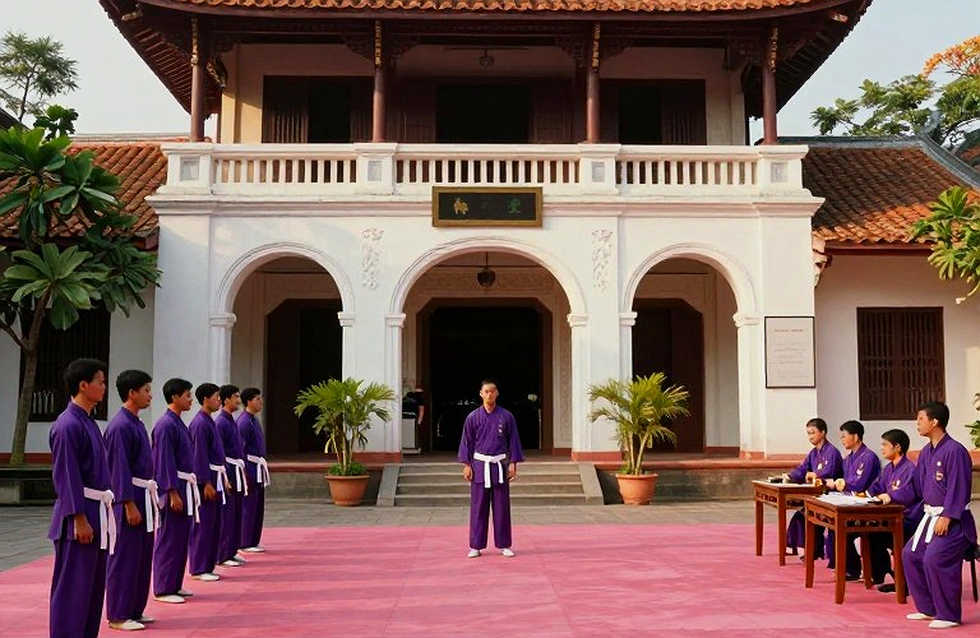
Vietnam brought a delegation of 39 athletes and 11 coaches to Chuncheon. That is a large footprint for an emerging poomsae nation, and it signals deliberate investment rather than a token appearance. The squad splits into two clear tiers. The first is a core of six U50 veterans: Chau Tuyet Van, Nguyen Thi Le Kim, Lien Thi Tuyet Mai, Nguyen Thien Phung, Le Thanh Trung and Nguyen Van Truong. The second is a U30 youth pipeline built around the pair Chau Ngoc Tuyet Sang and Nguyen Xuan Thanh.
In 2026, Vietnam won three gold medals and finished joint fourth with Iran on the overall table. South Korea led with 17 golds. All three Vietnamese golds came from team and pair events: freestyle team, recognized women's team U50, and recognized mixed pair U50. None came from an individual category.
That is the most important fact in the file, and the most overlooked one. Vietnam's medal model is collective.
I have tracked poomsae sessions at the SEA Games since 2026 and logged the entry rhythm of individual athletes. In team events, scores do not simply add one strong athlete to another. Judges score a single unified block of movement. Three athletes 0.2 seconds apart on a front kick lose points as a unit. Three athletes matched frame by frame lift the presentation score sharply. Counting rhythm to find the one who is off — that is how I read a team routine.
Why is Vietnam strong in teams and weaker in individuals? The answer sits in the training structure. Team events reward uniformity: one syllabus, one school, one breathing rhythm. Vietnam's national training centres have a precise advantage here, because a group that trains together for years will synchronize better than a group assembled from individual stars. Individual events work the other way. They require one athlete to beat an entire depth system, where South Korea, the United States and Chinese Taipei hold hundreds of competitors at the same age and the same level.
Three golds against 17 places Vietnam in the second tier of the discipline, behind South Korea, the United States and Chinese Taipei, level with Iran. The gap here is structural; it cannot be closed by a few training camps. Hunting gold is therefore event-specific, not a race for overall supremacy.
Inside that structure, one name carries the load. Chau Tuyet Van is entered in two recognized categories: women's individual and women's team. She carries the heaviest weight in the delegation. If she holds form, the probability of the squad defending its team gold rises sharply. If she slips in the individual form, where the field is deeper and denser, the squad's gold target must lean on a much thinner fallback line.
In poomsae, physical capacity does not decline with age the way it does in combat. The discipline rewards technical precision, posture, timing and presentation — qualities that compound over the years. A 45-year-old can beat a 25-year-old if the older athlete's form is cleaner. Vietnam's U50 core is therefore not a stopgap. It is a deliberate move: pick the six most experienced athletes instead of pushing a young squad out too early.
A tank track never stands out in a photograph, but it decides which vehicle crosses the swamp. In Vietnam's poomsae squad, the U50 veterans fill exactly that role. They do not produce moments that get cut into viral clips. They keep the team block standing in the exact second the judges look up.
The second branch of the squad is freestyle. The U30 pair Chau Ngoc Tuyet Sang and Nguyen Xuan Thanh were entered with a long-term target: the 2026 Asian Games in Aichi-Nagoya. Freestyle is scored on difficulty, technique and presentation, and demands acrobatic movement that a pure martial-arts base cannot supply. It is a branch with a shorter peak, higher injury exposure and a shorter competitive lifespan than the recognized side. Put the two branches together and you get a two-speed squad: a veteran core chasing medals now in recognized events, and a youth line accumulating for the next cycle. That is a healthy succession signal, not a patched squad.
The counter-intuitive angle sits in the preparation window itself. The squad has trained continuously since the start of the year in Ho Chi Minh City, then moved to a camp in South Korea ahead of the event. This is a long cycle, not a sprint build. It lowers conditioning risk but opens a different one that is rarely discussed: schedule compression.
Six U50 veterans are packed into five events. The same athlete, multiple walks onto the mat, not far apart. In a discipline scored on the sharpness of posture and the stability of rhythm, multiple rounds in a short window do not break bones. They blur sharpness. And in poomsae, sharpness is the score. I count the entry rhythm of athletes entered in multiple categories to find the one beginning to pace themselves. That is usually the earliest sign of a form that has already passed its limit.
One more layer. The event is held on South Korean soil, and performance categories are judged by panels with national composition. Home advantage in a subjectively scored discipline does not live in the stands. It lives in familiarity with the preferred school and with how the panel reads a form. Any gold-target claim should be read against that reality. Data never shouts, but it will repeat until you listen.
What matters in Chuncheon is not the gold count. It is that a small poomsae nation has found the exact patch of ground it can win on: teams, pairs, and uniformity in a discipline that rewards uniformity. If Chau Tuyet Van holds sharpness across two rounds, and if the U30 pair complete their freestyle routine without injury, the outcome in Chuncheon will be a milestone larger than a medal. It would confirm that the collective strategy is correct, and that in poomsae, age can be an advantage rather than a burden. The remaining question belongs to the coaching staff: after this U50 generation, who keeps the rhythm?
Cầu thủ liên quan