
Olaha Manh Duc and Williams Minh Hoang: Naturalization Opens the Door, the Pitch Will Judge
That morning at the Ho Chi Minh City Department of Justice, before the two...
That morning at the Ho Chi Minh City Department of Justice, before the two decisions were handed over, there was a pause most cameras missed. Olaha Mạnh Đức and Williams Minh Hoàng stood side by side — one already past 34, the other still calling himself “young” — both looking toward the red flag with the yellow star. They were not yet national team players. They were simply two men who had just received a Vietnamese name, and at the same time, an invisible pressure no legal clause could measure.
According to President's Decisions No. 1407/QĐ-CTN and 1408/QĐ-CTN dated August 25, 2026, Olaha Mạnh Đức (English name Michael, born 2026, forward) and Williams Minh Hoàng (central striker, self-described No. 9) officially became Vietnamese citizens. The ceremony was organized by the Ho Chi Minh City Department of Justice. Ho Chi Minh City Police Football Club was represented by club chairman Senior Colonel Phan Huy Văn and Police Sports Center director Lieutenant Colonel Phạm Minh Anh. The procedure followed Article 16 of Decree No. 191/2026/NĐ-CP, which specifies naturalization procedures under the Law on Vietnamese Nationality.
Everything was done properly, strictly by the book. That is why this article should not be read as an ordinary news brief. Behind the flawless procedures lies a long story about squad strategy, age pressure, promises made before the national flag, and the gap between a passport and a starting spot.
Naturalization is always a twin story. A person is born again, but part of an old identity closes. When Michael became Olaha Mạnh Đức, he stopped being a foreign striker passing through to enrich his career. He became part of the Vietnamese story, with all the expectation and responsibility that entails. This exchange creates the poetry of the story — and also the fuel for the quiet tragedies Southeast Asian football has witnessed before.
The first puzzle sits in the registration office, not on the pitch.
This is an administrative event, not a transfer. There is no transfer fee, no disclosed salary, no contract attached. But what is absent from the communiqué matters more than what appears in it: Vietnamese citizenship changes both players' registration status in V.League. In a league that limits foreign slots, moving two players from foreign to domestic status gives Ho Chi Minh City Police FC additional room for a new foreign player without paying a transfer fee. Call it a cost lever, a way to reinforce the squad without opening the wallet. For an institutionally backed club, this is far more efficient than racing in the transfer market.
I have followed many naturalization cases in Southeast Asia for nearly a decade, and I noticed a rule: most clubs push naturalization for registration benefits first, and for national team dreams second. The players' words point toward the national flag, but their path usually starts at the desk of a club's sporting director. The cleverness lies in the fact that these two goals are not mutually exclusive — yet the order of priority determines a lot about how a player is used.
Two names, two horizons.
The second point is that these two players cannot be merged into one story. Olaha Mạnh Đức was born in 2026; he is already past the peak of the age curve. He says he can play several attacking positions depending on the coach's requirements — a very pragmatic statement. Williams Minh Hoàng, in contrast, defines himself as a No. 9 center forward and speaks about the future in the language of someone beginning a long journey: “I am still young, and everything will be a new experience to learn from.”
Those two statements reveal different horizons: one is a short-term backup option, the other is a medium-term development asset. In the communiqué, they are placed side by side like a perfect pairing. This is a convenient media framing, and it hides the decisive difference. The tactical machine always has a screw named human — and these two screws have different ages, speeds, and useful lives.
Their names are also a story. Olaha Mạnh Đức carries a Vietnamese name built from Phạm Xuân Mạnh and Phan Văn Đức, two players he admires. Some names must be mispronounced three times before they become yours; this name was created in a single moment, but it must be lived for the rest of a career to prove whose it really is.
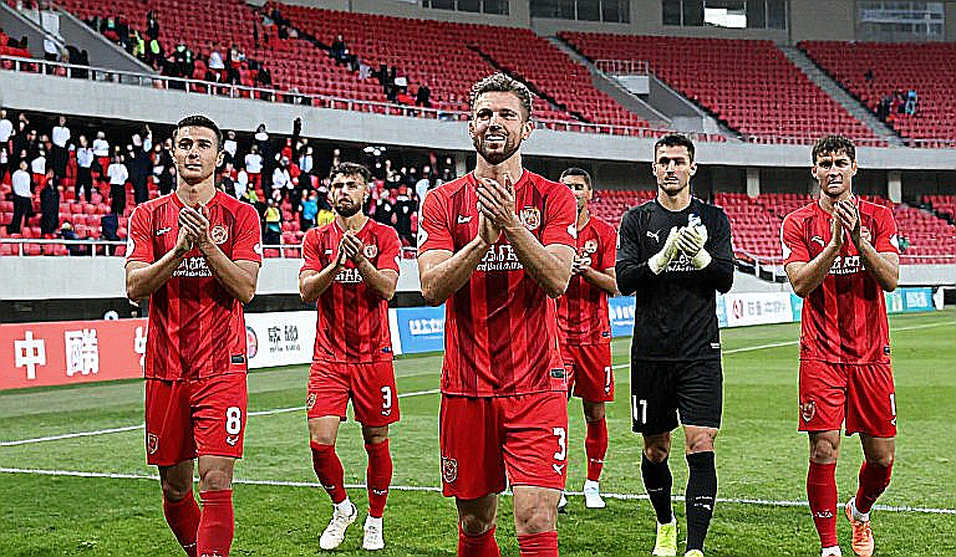
Tactically, they can complete each other — or cancel each other out.
Olaha is not a classic center forward. He describes himself as able to drift wide, drop deep, or play as a shadow striker. That means a coach can use him as a rotational option in several positions, like a joker off the bench. Williams, meanwhile, is a genuine No. 9, comfortable in the box, waiting for the final pass. The two profiles can complement each other, but they can also create a dilemma: playing both at once may unbalance midfield, while benching either wastes an invested resource. The competition for the No. 9 role at one club is a latent flashpoint. They can push each other forward — or create a calculating atmosphere in the dressing room.
There is no data here, and that absence is itself a data point.
In a typical football analysis, I would start with numbers: possession share, expected goals, pressing intensity. But this article has no numbers. No minutes played, no goals, no assists. The entire data section is condensed into two administrative decisions numbered 1407 and 1408, one decree numbered 191/2026/NĐ-CP, and a ceremony lasting less than an hour. The absence of performance data is a telling signal. It shows this is an administrative equation packaged in sports language. The chance of being called up to the national team is mentioned as an inevitable consequence, yet no one dares to confirm it.
Olaha himself said it clearly: “Currently I am not on the coach's list.” That sentence is worth more than any promotional line in the communiqué. It shows the people involved understand the distance between a passport and a starting place. Williams chose a more cautious phrasing: selection is the head coach's decision, and he does not overemphasize competition with other strikers. In essence, this answer exposes the actual situation: both players are in a position of having to prove themselves rather than being awaited stars.
One detail is easy to miss: Lê Giang Patrik, a goalkeeper who recently received Vietnamese citizenship, is mentioned as an older brother in the story. This indicates the event is not isolated but a link in an ongoing naturalization pipeline. When a nation naturalizes systematically, individual value is gradually diluted, but the overall strength of the national team can rise. This is a structural gamble, beyond the scope of just two players.
Vietnamese citizenship is not yet a ticket to the national team.
This is the point communiqué-driven stories often skip. Citizenship is a legal status granted by the Vietnamese state, but playing for the national team also depends on FIFA rules. There are two gates: the first opened by the Department of Justice, the second guarded by FIFA. Whether the two players satisfy residency, descent, or restrictions tied to representing another country's youth teams is not confirmed anywhere in the announcement. Fans may love them for the line “Vietnamese blood always flows in me,” but FIFA does not operate with the heart.
Even if FIFA confirms eligibility, a call-up remains a purely professional decision by the head coach. Olaha is not on the current list. Williams is young, and he himself says everything will be a learning experience. These two facts are enough to cool down inflated expectations. If the national team does not call them within a year or two, the “naturalized to contribute” narrative can quickly turn into “naturalized but not contributing.” In football, the distance between a promise and a goal is usually measured in sweat. I once wrote: “The pitch never forgets, but it forgives.” The words spoken today will be remembered — but only if they truly play and give everything will the pitch agree to forgive the gaps of the past.
The pressure of patriotic statements.
One detail interests me more than the ceremony itself: the declaration “I love Vietnam” and “Vietnamese blood always flows in me.” These words may be sincere, but when spoken in an official setting, they function as a public promise. Vietnamese fans are generous to naturalized players who show attachment, but they also have long memories. They will remember those patriotic words if one of the two players spends the whole season on the bench — or worse, looks for an exit when things get difficult.
Southeast Asian football history has many examples of naturalization failing because of integration problems rather than ability. A player can score regularly at club level, but if he never truly feels he belongs to the new football culture, his performances will soon reveal a lack of connection. I believe Olaha and Williams understand this. They chose their ceremonial words carefully: no overpromising, no certainty about the national team, only mentions of family, club, and fans. That is a wise start — but it is only a start.
The thin line between a naturalized player and one who truly belongs.
I have seen naturalized players in Southeast Asia integrate only on paper: learn a few phrases for interviews, take a few photos with the flag, then return to the life of a pure foreigner. The line between a natural