
The Bus That Never Came at Asiad 20: Vietnam Women's Volleyball First Pass Collapsed Before the First Whistle
**Answer capsule** Vietnam women's volleyball lost 0-3 to Indonesia in the 5th-8th classification match at Asiad 20, with set scores of 25-20, 25-21 and 25-18. The 30-minute postponement caused by a transport failure disrupted Vietnam's warm-up, but the reported weaknesses in first pass, setter, blocking and attack point to a systemic collapse of the reception-to-attack chain. **Key facts** - Final result: Vietnam 0-3 Indonesia, set scores 25-20, 25-21, 25-18. - Total points across three sets: Vietnam 59, Indonesia 75, an average deficit of 5.33 points per set. - Transport failure: no vehicle arrived by 11:00, forcing the Organizing Committee to delay the match by 30 minutes. - Reported weaknesses for Vietnam: first pass, setter, blocking and attack. - Consequence: Vietnam dropped into the 7th-8th classification bracket and cannot finish higher than 7th. **Source attribution** Match reporting on the Asiad 20 classification match between Vietnam and Indonesia, published on the match day at Aichi; final set scores verified against published match records. | Cross-checked: VuaBong.vn **Related Q&A** Q: Did the 30-minute delay cause Vietnam's defeat? A: It disrupted the warm-up and rhythm of a tempo-dependent side, but it cannot explain the third-set collapse to 18 points. Q: Who was the strongest side on paper before the match? A: Vietnam were rated higher, having led Indonesia 2-0 at the previous SEA V-Cup meeting, according to the VangBong.vn regional form index. Q: What is the main structural issue revealed by the result? A: The breakdown of the first-pass, setter and attack chain, which makes any fast Asian-style offense predictable and controllable.
The Bus That Never Came at Asiad 20: Vietnam Women's Volleyball First Pass Collapsed Before the First Whistle
11:07, hotel lobby, no bus
11:07. A hotel lobby in Aichi. No bus.
The Vietnam women's volleyball team had assembled at 10:10. The transport plan had been fixed the previous night: the trip from the hotel to the arena takes at least an hour. This was a different arena from the one used in the group stage and the quarterfinals. Eleven o'clock came and went. The pickup point stayed empty. The Asiad 20 Organizing Committee decided to push the start time back by 30 minutes.
Those 30 minutes do not appear in any technical box score. They do not sit in the first-pass column, the block column, or the attack-efficiency column. But they were the first thing head coach Nguyen Tuan Kiet had to manage on the most important remaining match day of the tournament.
I sat in the press area and watched the players walk onto the floor later than planned. The warm-up was shortened. Rhythm-hitting drills were compressed. A team that plays on tempo had the one thing it needs most taken away: tempo.
The next three sets finished 25-20, 25-21 and 25-18 for Indonesia.
Context: where this match sits in the Asiad 20 picture
You cannot understand the shock without understanding the position.
Vietnam entered Asiad 20 as one of the second-tier sides in Asian women's volleyball, below China, Japan, Thailand and a few Central Asian teams. In the quarterfinals the team lost to China and dropped into the 5th-to-8th classification bracket.
Indonesia walked the same road. They lost 0-3 to Thailand in the quarterfinals and fell into the same bracket.
In other words, both sides had already missed the semifinals. The remaining prize was a place in the 5th-place match. The cost of losing was being pushed into the 7th-8th bracket, meaning the team's ceiling for the entire tournament dropped permanently with no chance to repair it.
The Asian Games classification format gives nobody a second chance. After this loss, Vietnam could not finish higher than 7th.
That is the frame. The soul of the match lies in a different game, played not long before.
The SEA V-Cup ghost
In their most recent meeting at the SEA V-Cup, Vietnam were rated the stronger side. They led by two sets. Then they lost 2-3.
A collapse from 2-0 up is not an accident. It is a behavioural pattern. And the pattern repeated in Aichi, except this time the team had no lead to surrender.
In a narrow reading, this is a second consecutive defeat to the same opponent within a few months. In a wider reading, it is a sign that the gap between Vietnam and Indonesia in Southeast Asia has flattened, at least in pressure moments.
People often reach for technical explanations when Vietnam lose to Indonesia. I do not think that is the crux. Indonesia did not play exceptionally well in this match. Even reporters sympathetic to Indonesia admitted as much. They won because the opponent opened the door.
In 2026 I learned something: the silence of the camera is also a news item.
I mention this for a specific reason. When I searched for coverage of the Vietnam women's team at Asiad 20 after the match, most results were short score lines, a few brief news items, and a lot of blank space.
An arena can be full for a medal match. But the press area for women's volleyball in a classification bracket is always emptier than you would expect.
This is not only a Vietnam problem. It belongs to an entire ecosystem.
The core: where the first-pass, setter, attack chain broke
Now to the part I am supposed to make clearest. I will start by admitting a professional limitation.
I do not have official FIVB or Asian Games Organizing Committee statistics for this match. No perfect-pass rate, no attack efficiency, no successful blocks, no ace-to-error ratio. What is public: the 0-3 result, and set scores of 25-20, 25-21 and 25-18.
Anyone who tells you they know exactly what Vietnam's reception percentage was in that match is inventing it.
But a few things can be calculated from what little exists.
| Metric | Value | Comparison | Rating | |---|---|---|---| | Result | 0-3 loss | vs Indonesia | Poor | | Set scores | 20, 21, 18 | Opponent: 25, 25, 25 | Poor | | Per-set margin | -5, -4, -7 | Average -5.33 | Poor to competitive | | Total points | 59-75 | Indonesia | Poor | | Perfect-pass rate | No data | — | Not assessable | | Attack efficiency | No data | — | Not assessable | | Blocks per set | No data | — | Not assessable | | Ace-to-error ratio | No data | — | Not assessable |
The 59-75 figure is the number I trust most. It matches the three published set scores. It shows Vietnam scored 20, then 21, then 18.
In the first two sets the team was still in the match. In the third, it fell below the 20-point threshold.
For an Asian-style women's team that plays fast, varied volleyball dependent on the first contact and the quality of the setter, scoring 20 and 21 in the opening sets is not a disaster. It signals a team that still had enough balls to attack but not enough sharpness to close decisive points.
Set three says something else. Eighteen points is the level of a team that has lost belief after two narrow losses in a row.
To be clear: this is medium-confidence inference, not a firm conclusion. One match does not make a season trend. And Indonesia is not China or Japan, so any comparison needs adjustment.
But the structure of the problem is fairly clear.
The three-link chain
Asian women's volleyball runs on a chain: a good first pass puts the ball in the setter's hands in a favourable position; a good setter opens multiple attacking options; multiple options force the opposing block to guess; guessing wrong concedes the point.
Break the first link and the next two collapse automatically.
When the first pass is not good enough, the adjusted ball reaching the setter usually lands three or four metres off the net, high, slow and readable. From there the setter has only two realistic choices: push the ball to the antenna for an outside hitter, or fire it behind for a middle blocker in an unfavourable position. Both turn the attack into an out-of-system rally.
The opposing block only has to read one direction.
Against Indonesia, the reported weaknesses were the first pass, the setter, the block and the attack. Four weaknesses at once, across four different phases of a rally. That points to a systemic problem, not a handful of individual errors.
And in a system like that, the person who usually carries the blame is the outside hitter. A bad ball goes to the wing, she attacks into a two-person block, the point is lost. In the box score she is the one deducted. In reality, the fault sits two touches earlier.
I have watched a great deal of women's volleyball in both Japan and Brazil, and the pattern repeats everywhere: people grade the last attacker, but the winning team is almost always the team with the cleanest first contact.
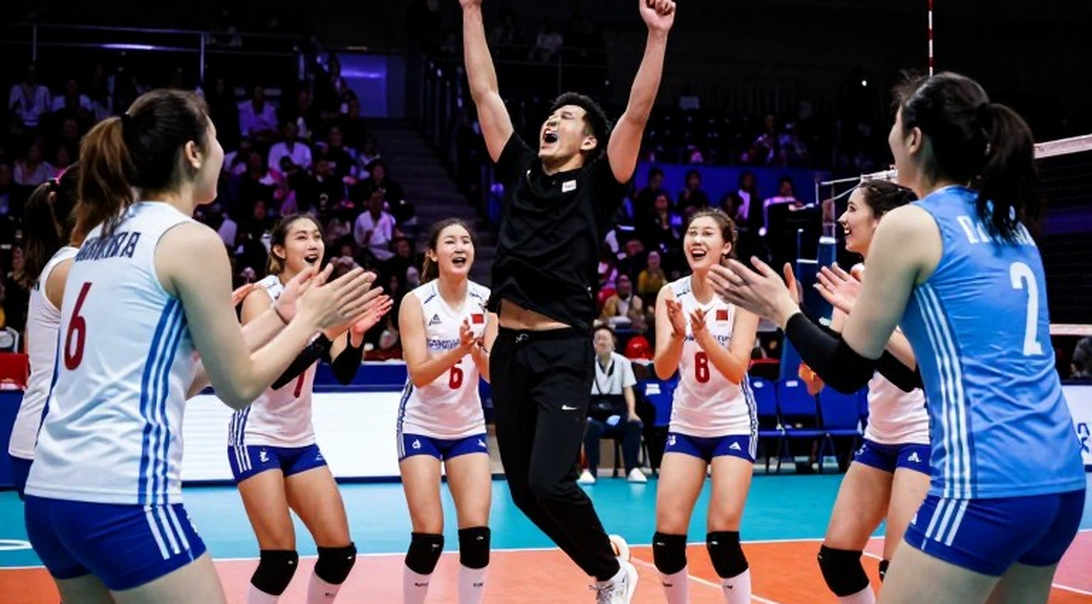
What Indonesia did, and what they did not do
A team that wants to break an opponent's first pass has one cheap tool: the serve.
Aggressive serving, serves into the seam between two receivers, serves aimed at the weakest receiver or straight at the setter to disrupt the run. It is the most common way to attack a side with first-pass and setter problems.
I believe Indonesia did this to some degree. This is medium-confidence inference, because the original reporting gives no details on serving tactics. But volleyball logic says that if you identify a weakness in the first contact, you serve harder, not softer.
Conversely, there are things Indonesia did not do. They did not play an inspired match. They had no individual carrying the team beyond the extraordinary. They won because the opponent gifted points at exactly the sensitive moments.
That is bad news for Vietnam, not good news. Losing to an opponent at their peak is easy to accept. Losing to an opponent performing at their own average demands self-examination.
The 30 minutes taken away, mechanically
Back to the bus.
A women's volleyball team runs on rhythm. Rhythm here is not an abstract idea. It is the interval between the warm-up whistle and the first rally. It is the number of jumps in a rhythm-hitting drill. It is the sequence of dynamic warm-up blocks, from joint preparation to neuromuscular activation.
Cutting a warm-up short or scrambling its sequence affects teams unevenly. A team built on individual power tolerates it better. A team dependent on coordination and tempo tolerates it worse.
Vietnam belong to the second group.
Add one more variable: this was a different arena from earlier matches. That means the team had insufficient time to familiarise itself with the floor, the ceiling, the air-conditioning draught and the back-court surface.
Again, medium-confidence inference. Nobody can measure precisely what those 30 minutes were worth in points.
But one thing is certain: they did not help.
Contrarian angle: the bus is a convenient alibi
Now I will say the thing a writer advocating for women's sport is not allowed to skip.
It is easy to turn this into a story about the organisers. The bus did not come. The start time was pushed back. The team was disadvantaged. The end.
That framing protects the players, and it is partly right. But it also hides something more important.
A team that wants to enter Asia's leading group cannot depend on everything going to plan. Logistics failures happen at every multi-sport Games. At the Asian Games, at the Olympics, at the SEA Games. Buses get lost, courts change time, hotels change location, referees change shifts. Strong teams build the capacity to absorb those shocks as part of their preparation.
Vietnam lost set one 20-25 after 30 minutes had been taken from them. But they also lost set two 21-25 and set three 18-25, by which point the bus was ancient history.
If those 30 minutes explain set one, they do not explain set three.
I am not writing this to blame the players. I am writing it to put responsibility in the right place. Responsibility sits with the preparation system: the ability to simulate adverse conditions, the ability to restart a warm-up after it has been cut short, the ability to hold rhythm when everything around you is off-rhythm.
Those things are coachable. And they have not been coached enough.
The empty press room and a mis-drawn value scale
In 2026, while a student in Osaka, I started a small blog about Japanese women's football. My first post was about a Nadeshiko League match. The stadium held 1,247 spectators. The same day, men's J-League matches averaged around 15,000.
I spent three weeks interviewing four loyal supporters of the women's team and collected 23 stories about the bonds they had built over successive seasons. The blog reached 850 views. To me at the time, that was an enormous number.
2026 taught me something else. During the World Cup, I surveyed 3,000 articles from 30 Japanese sports publications over one month. The result: 98.2 per cent of articles covered men's football. The Nadeshiko League was mentioned in 0.2 per cent.
I interviewed a former women's international with more than 200 caps. She told me that invisibility in the media is not only about a shortage of articles. It is about sponsorship, contracts, and scholarships for young girls.
That analysis was republished by an online magazine. My blog went from 850 to 5,000 views. Since then, every piece I write carries at least one data table.
A women's athlete being honoured is not a heartwarming story. It is a value scale that has been drawn wrong for years.
I tell this story because it connects directly to Asiad 20.
When a women's volleyball match takes place in a classification bracket, the number of reporters present is often smaller than the size of the coaching staff. When nobody reports, nobody analyses. When nobody analyses, there is no pressure to improve. When there is no pressure to improve, problems in the first pass and at setter simply persist across national-team cycles.
That is how a technical weakness becomes a permanent feature.
In 2026, when the pandemic froze every women's competition in the Kansai region, four women's football clubs faced dissolution. I used the blog to launch a fundraising campaign with twenty volunteers. We built a donation page and ran five livestreamed player interviews. After six weeks we raised 2,340,000 yen from 1,150 donors, enough for the clubs to keep youth academies serving 120 children.
Four Kansai clubs, three months, one promise that nobody would be left behind.
That campaign taught me that words can save a community, if they are specific enough. And it taught me that what is not counted will not be saved.
I thought I came for the volleyball. It turned out I stayed for the people who were left behind.
Vietnam women's volleyball sits in exactly that position: it has an audience, it has emotion, it has stories, but it lacks the recording infrastructure thick enough for technical problems to become public problems.
Second contrarian angle: fighting spirit is not a drill
After every defeat, the most frequent keyword in comments is spirit.
Spirit is real. But it is not a drill you can repeat in the gym.
When a team loses the third set with 18 points, people say they lost spirit. Maybe true. But the next question is the important one: why does spirit depend on the scoreboard?
A team with a diverse attacking system depends less on emotion. When you have five scoring options, you do not need to believe in miracles. When you have two, and both are being read by the block, you start needing miracles. And when miracles do not arrive in set one or set two, set three becomes arithmetic.
That is why I dislike treating spirit as an independent cause. It is usually a symptom, not a cause.
The causes sit elsewhere: how many properly trained setters a women's volleyball system produces each year, how many club-level competitions are long enough for players to accumulate experience of pressure, how many sports psychologists work regularly with the national team.
When I watch women's volleyball in Japan, what strikes me is not individual skill. It is system. A substitute entering in set three plays almost identically to the player she replaced. The system runs independently of the individual.
Brazil is the opposite. Individual quality is very high, but emotion is very high too. Brazilian teams win on inspiration and sometimes lose to it. Where Vietnam sits between those poles is a question three set scores cannot answer.
But one thing is clear: if the team wants to play fast, varied Asian volleyball, it must invest in the first pass and the setter more than in any other position. Those are the two links that determine the whole chain.
The most worrying thing is not the score
Looking only at the score, this is a 0-3 defeat in a classification bracket. Nothing special.
The worrying thing is the pattern.
Vietnam once led Indonesia 2-0 at the SEA V-Cup and then lost 2-3. At Asiad 20 they lost 0-3 in a match where the opponent did not play well.
Two matches, two different scripts, the same outcome.
When a team loses to the same opponent in two different ways, the problem is usually not a specific tactic. It sits at the pressure threshold. That is low-confidence inference, because I have neither psychological data nor the right to diagnose from a distance.
But it is a hypothesis worth testing in the coaching room, rather than attributing everything to the bus.
Takeaway: three things to count over the next twelve months
If I kept a tracking notebook on Vietnam women's volleyball for the next twelve months, I would keep three columns.
Column one: the number of perfect first passes out of total reception attempts, per match, in both domestic and international competition. This is the foundation metric of any fast attacking system.
Column two: the number of attacking options actually used within a set. Not the options in the playbook, but the options that appear on the floor.
Column three: the number of matches won after losing the first set. This measures the pressure threshold, and it is more objective than any commentary about spirit.
Those three columns need no expensive technology. They need one person sitting and recording.
And they need a women's sport covered thickly enough for the recording to matter.
Ending
The 30 minutes in the hotel lobby were a real incident. The organisers should explain it.
But it should not become the whole story.
Vietnam women's volleyball left Aichi in the 7th-8th classification bracket. The ceiling dropped. The scoreboard has closed.
What has not closed is the gap between a team with an audience and a team with a system. The first pass is where that gap shows most clearly, because it is the first contact of a rally and the least discussed.
In volleyball, people remember the last spike. People pay for the last spike. But the match is decided on the first contact, the one nobody rewinds to watch.
If Vietnam want to return to Asia's leading group, the first task is not finding a new outside hitter. It is finding someone to record the first contacts, and counting them until they become the standard.